

CD99 (MIC2)
CD99 (MIC2), a 32-kDa transmembrane protein, which has shown strong expression levels on various cancer cell types, including Ewing sarcoma, T-cell lineage leukemia/lymphoma, breast cancer (including triple-negative breast cancer; TNBC), acute myeloid leukemia (AML), and myelodysplastic syndromes (MDS), is involved in various biological processes, including cell differentiation, cell adhesion, trans-endothelial migration of leukocytes, T-cell regulation and protein trafficking, cell apoptosis, and tumorigenesis. [1][2][3][4][5][6]
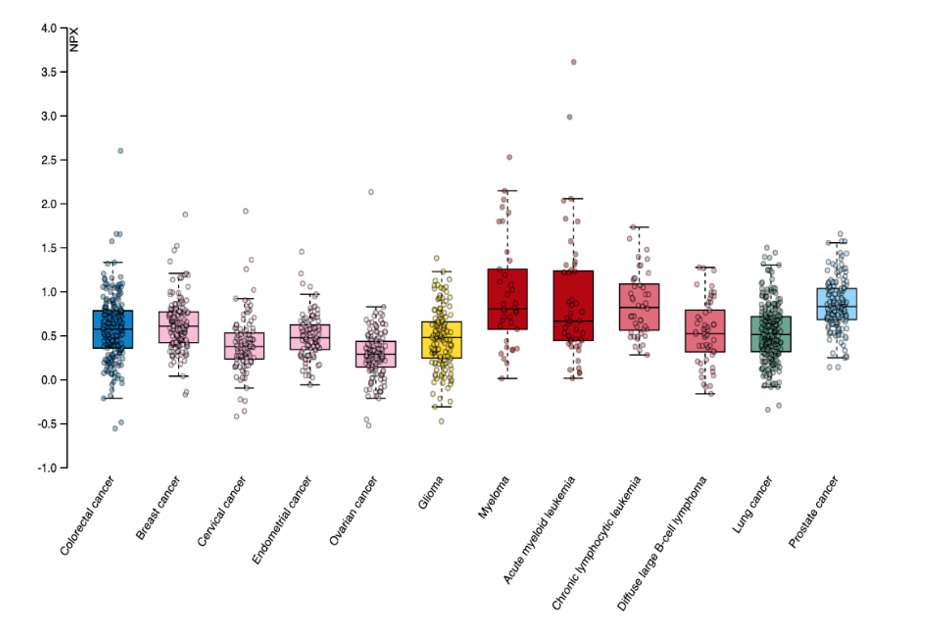
In tumors, CD99 has been observed to impact migration, invasion, and metastasis through multiple mechanisms of action (MOA), making it a novel therapeutic target.
While the expression of CD99 has been observed in many cancers, researchers have also observed CD99-expression to be highly upregulated in many cancers that have not been historically identified as expressing CD99.
Although widely expressed on many cell tumor surfaces, CD99 is largely absent on normal, healthy, cells, making it an attractive target for a targeted drug development program. [2][8][9](Figure 1.0)
CD276/B7H3
CD276, also known as B7 homolog 3 protein or B7H3, is a cell surface tumor endothelial marker and a member of the B7 ligand family, which includes immune checkpoint molecules CTLA-4 ligands and PD-L1. CD276 is over-expressed on differentiated malignant cells and cancer-initiating cells, with limited heterogeneity, and high frequency, while showing limited expression in normal, healthy tissues. Several studies have reported that over-expression of CD276 is associated with poor prognosis in several types of cancers [10]
CD276 has a predominantly inhibitory role in adaptive immunity, suppressing T-cell activation and proliferation. In contrast, in malignant tissues, CD276 inhibits tumor antigen–specific immune responses, leading to a protumorigenic effect [10]
In pre-clinical development a number of CD276-based immunotherapy strategies, including our investigational novel format nano-ADCs likeTargeted NanoSpheres (nADC/TNS) NV103 have demonstrated potent anti-tumor activity with acceptable safety profiles in pre-clinical models.
In contrast to traditional antibody-drug conjugates (ADC), which are only effective against targets with a high level of expression on tumors, NV103 targets CD99 and CD276 (B7H3) with different expression levels on a wide variety of tumor cells. NV103 binds to tumor cells more than any normal tissue resulting in enhanced drug delivery to tumors while limiting exposure of normal tissue resulting in reduced toxicity.[6] This approach enables ‘combat’ low off-target toxicity and drug resistance, while, at the same time, realizing broader and longer-lasting killing effects for heterogeneous tumors.
CD99 and CD276 on Glioblastoma Cells
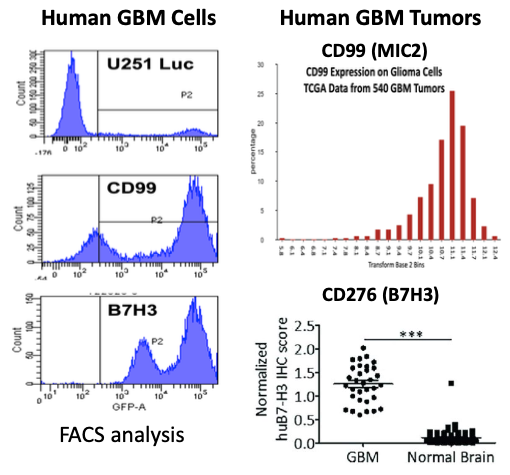
CD99 (MIC2) and CD276 (B7H3) are expressed on glioblastoma (GBM) cells. They are intrinsic membrane proteins uniformly expressed on all CD276 (B7H3) and nearly on all CD99 (MIC2) tumor cells. Both antibodies bind equally well to both human and mouse tissue, enabling mouse xenograft and syngeneic tumor studies. (Figure 1.1)
Reference
[1] Chung SS, Eng WS, Hu W, Khalaj M, Garrett-Bakelman FE, Tavakkoli M, Levine RL, Carroll M, Klimek VM, Melnick AM, Park CY. CD99 is a therapeutic target on disease stem cells in myeloid malignancies. Sci Transl Med. 2017 Jan 25;9(374):eaaj2025. doi: 10.1126/scitranslmed.aaj2025. PMID: 28123069; PMCID: PMC5624309.
[2] Pasello M, Manara MC, Scotlandi K. CD99 at the crossroads of physiology and pathology. J Cell Commun Signal. 2018 Mar;12(1):55-68. doi: 10.1007/s12079-017-0445-z. Epub 2018 Jan 6. PMID: 29305692; PMCID: PMC5842202.
[3] Kotemul K, Kasinrerk W, Takheaw N. CD99 tumor associated antigen is a potential target for antibody therapy of T-cell acute lymphoblastic leukemia. Explor Target Antitumor Ther. 2024;5(1):96-107. doi: 10.37349/etat.2024.00207. Epub 2024 Feb 19. PMID: 38468825; PMCID: PMC10925484.
[4] Manara MC, Pasello M, Scotlandi K. CD99: A Cell Surface Protein with an Oncojanus Role in Tumors. Genes (Basel). 2018 Mar 13;9(3):159. doi: 10.3390/genes9030159. PMID: 29534016; PMCID: PMC5867880.
[5] Ambros IM, Ambros PF, Strehl S, Kovar H, Gadner H, Salzer-Kuntschik M. MIC2 is a specific marker for Ewing’s sarcoma and peripheral primitive neuroectodermal tumors. Evidence for a common histogenesis of Ewing’s sarcoma and peripheral primitive neuroectodermal tumors from MIC2 expression and specific chromosome aberration. Cancer. 1991 Apr 1;67(7):1886-93. doi: 10.1002/1097-0142(19910401)67:7<1886::aid-cncr2820670712>3.0.co;2-u. PMID: 1848471.
[6] Kang LC, Dunphy CH. Immunoreactivity of MIC2 (CD99) and terminal deoxynucleotidyl transferase in bone marrow clot and core specimens of acute myeloid leukemias and myelodysplastic syndromes. Arch Pathol Lab Med. 2006 Feb;130(2):153-7. doi: 10.5858/2006-130-153-IOMCAT. PMID: 16454553.
[7] Scotlandi K, Baldini N, Cerisano V, Manara MC, Benini S, Serra M, Lollini PL, Nanni P, Nicoletti G, Bernard G, Bernard A, Picci P. CD99 engagement: an effective therapeutic strategy for Ewing tumors. Cancer Res. 2000 Sep 15;60(18):5134-42. PMID: 11016640.
[8]Cardoso LC, Soares RDS, Laurentino TS, Lerario AM, Marie SKN, Oba-Shinjo SM. CD99 Expression in Glioblastoma Molecular Subtypes and Role in Migration and Invasion. Int J Mol Sci. 2019 Mar 6;20(5):1137. doi: 10.3390/ijms20051137. PMID: 30845661; PMCID: PMC6429353.
[9] Hofland P. A more Targeted Approach in Pediatric Cancer Therapy? Onco’Zine. August 18, 2021. DOI: 10.14229/onco.2021.08.21.001
[10] Zhou WT, Jin WL. B7-H3/CD276: An Emerging Cancer Immunotherapy. Front Immunol. 2021 Jul 19;12:701006. doi: 10.3389/fimmu.2021.701006. PMID: 34349762; PMCID: PMC8326801.